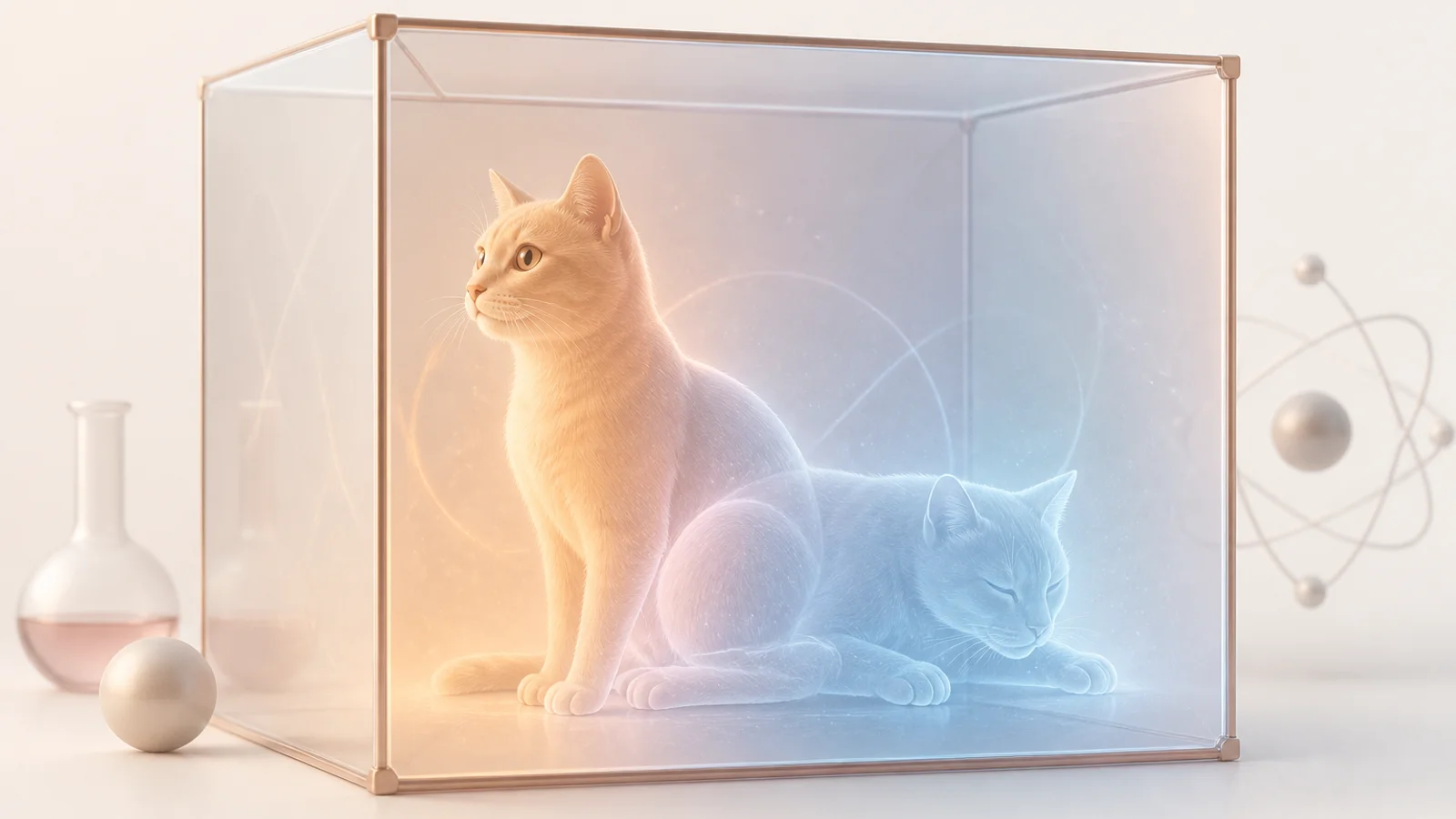
Schrödinger’s cat has had a very strange career.
Most cats become famous by knocking things off tables, staring into corners, or looking personally betrayed by closed doors.
This one became famous by being possibly alive, possibly dead, and definitely trapped in one of the most misunderstood thought experiments in physics.
You have probably heard some version of it:
A cat is in a box. Until someone opens the box, the cat is both alive and dead.
That sentence is memorable.
It is also the reason many people walk away thinking quantum physics is basically haunted nonsense with better equations.
So let’s slow down.
Schrödinger’s cat is not mainly a story about a cat.
It is a story about what happens when the weird rules of the quantum world are pushed into the everyday world we actually live in.
The cat is there to make the weirdness impossible to ignore.
Which is a very cat-like job, honestly.
The simple version
Schrödinger’s cat is a thought experiment created by physicist Erwin Schrödinger in 1935.
A thought experiment is not something you actually do in a lab.
No real cat needs to be placed in a box.
Good. I would like that written very clearly on the wall.
The experiment imagines a sealed box containing:
- a cat;
- a tiny radioactive source;
- a detector;
- a device that could release poison if the detector registers decay.
The setup is arranged so that, after a certain time, there is a chance the radioactive atom has decayed and a chance it has not.
If it decays, the detector triggers the mechanism, and the cat dies.
If it does not decay, the cat lives.
The strange part comes from quantum mechanics.
Before measurement, the radioactive atom can be described as being in a superposition of decayed and not decayed.
If the fate of the cat depends on that quantum event, then the whole box seems to become linked to the superposition.
So, in the simplified popular version:
Until the box is opened, the cat is described as both alive and dead.
This is not because physicists hate cats.
This is because quantum theory does strange things when you ask what counts as a measurement.
What Schrödinger was actually doing
Here is the twist people often miss:
Schrödinger was not saying:
“Great news, everyone. Cats can be alive and dead now.”
He was pointing out how absurd quantum ideas can look when stretched into normal life.
The cat was meant to show a problem.
In the quantum world, particles can be described by multiple possible states at once until measurement.
That idea works very well mathematically for tiny systems.
But what happens when that tiny quantum event affects a large everyday object?
Like a cat.
Or a measuring device.
Or anything big enough that we expect it to have one clear state.
Schrödinger’s cat asks:
Where does the quantum weirdness stop and ordinary reality begin?
That is the real question.
The cat is the dramatic prop.
A very memorable, emotionally manipulative prop.
Superposition: the word everyone trips over
Superposition is one of those physics words that sounds like it was invented to scare beginners away from the snacks table.
The simple version:
Superposition means a quantum system can be described as being in a combination of possible states before measurement.
That does not mean a tiny object is simply “doing two normal things at once” in the everyday sense.
It means the math used to describe the system includes multiple possible outcomes.
For example, a quantum system may not have a definite measured value until interaction or measurement happens.
This is very different from normal uncertainty.
If I put a cookie in one of two boxes and you do not know which box it is in, the cookie is still definitely in one box.
You are uncertain.
The cookie is not.
Quantum superposition is stranger than that.
Before measurement, the system is not just hiding a normal answer from you. The theory describes it as a combination of possible outcomes.
This is where intuition starts sweating.
And fair enough.
Human intuition evolved for things like fruit, weather, and whether a shadow might be a predator.
It did not evolve for quantum measurement.
Measurement: the awkward part
In everyday life, measuring something sounds passive.
You check the temperature.
You weigh an apple.
You look at the time.
The thing is what it is, and you are just finding out.
Quantum measurement is more complicated.
In many interpretations of quantum mechanics, measurement is connected to the system taking on one definite outcome from a range of possibilities.
This is sometimes described as the collapse of the wave function.
That phrase sounds dramatic because it is.
A wave function is a mathematical description of a quantum system. It contains information about possible outcomes.
When a measurement happens, we observe one result.
The difficult question is:
What exactly counts as a measurement?
Is it a detector?
A human observer?
Interaction with the environment?
A permanent record?
A conscious mind?
A large enough system?
This is one reason Schrödinger’s cat became so famous.
It takes the measurement problem and turns it into something emotionally obvious:
Surely the cat is not literally waiting in a ghostly alive-dead blur until a person opens the box?
Right?
Please?
The thought experiment forces us to ask where the line is.
The cat is not the main mystery
It is tempting to focus on the cat.
That is understandable. The cat has branding.
But the real mystery is not:
Can a cat be alive and dead?
The real mystery is:
How do quantum possibilities become one observed reality?
That question is still philosophically and scientifically deep.
Different interpretations of quantum mechanics answer it differently.
Some interpretations say the wave function collapses during measurement.
Some suggest all outcomes happen in branching worlds.
Some focus on the role of information.
Some focus on how interaction with the environment destroys visible quantum weirdness for large objects.
That last idea is connected to decoherence.
Decoherence helps explain why big everyday objects do not usually behave like delicate quantum systems. They interact constantly with their surroundings: air, light, heat, particles, surfaces, everything.
A cat in a box is not isolated like a tiny particle in a clean experiment.
It is a warm, complex, breathing system.
With opinions.
Probably many opinions.
Why we do not see everyday superpositions
If quantum mechanics allows superposition, why do we not see chairs being both here and there?
Why is my coffee not both full and empty until I look at it?
Actually, my coffee becomes empty whether I observe it or not, which feels like a personal flaw in the universe.
But the bigger answer is that large objects interact with their environment constantly.
Tiny quantum systems can sometimes be isolated carefully enough for superposition to matter in visible experiments.
Large objects are messy.
They are made of enormous numbers of particles.
They bump into air molecules.
They emit heat.
They absorb light.
They interact with the world so much that delicate quantum effects become impossible to observe in the simple “both states at once” way people imagine.
This is part of why the cat example is so dramatic.
A cat is not a single isolated particle.
A cat is a large biological chaos package wrapped in fur.
The thought experiment intentionally connects the tiny quantum world to the big everyday world to make the conceptual problem uncomfortable.
And it works.
Everyone remembers the cat.
What the thought experiment teaches
Schrödinger’s cat teaches a few important ideas.
First:
Quantum systems do not behave like everyday objects.
That sounds obvious until you try to explain exactly where one becomes the other.
Second:
Observation and measurement matter in quantum mechanics.
The act of measuring is not just a casual peek. It is connected to how the system’s possible states become an observed result.
Third:
The theory works extremely well, but interpreting what it means is hard.
Quantum mechanics is one of the most successful scientific theories ever developed. It predicts experimental results with incredible accuracy.
But the interpretation of what is “really happening” underneath the math is still debated.
This is important.
A theory can work beautifully and still leave humans arguing about what it means.
Humans do this with text messages too, but quantum mechanics has better equations.
Common misunderstandings
Schrödinger’s cat is famous, and famous ideas collect misunderstandings like sweaters collect lint.
Let’s clear a few.
”The cat is literally both alive and dead”
This is the popular version, but it is too blunt.
The thought experiment shows how strange it would be if quantum superposition applied directly to a cat in the same way it applies to a tiny quantum system.
It is not a practical claim that cats normally exist in alive-dead superpositions.
Please do not use quantum physics to avoid feeding your cat.
”Looking at something creates reality”
This is also too simple.
Quantum measurement is not just “a human looks and reality happens.”
The role of observation is subtle, and different interpretations explain it differently.
Interaction with measuring devices and the environment can matter.
A conscious human observer is not always required in the simple magical sense people sometimes imagine.
The universe was doing physics before anyone invented lab coats.
”Quantum mechanics means anything is possible”
No.
Quantum mechanics is strange, but it is not permission for every random claim.
It has rules.
Very precise rules.
The fact that tiny systems behave in surprising ways does not mean thoughts control reality, cats can teleport because vibes, or your lost keys are in a quantum dimension.
They are probably under something.
”Scientists do not understand quantum mechanics at all”
Also no.
Scientists understand the math extremely well in many contexts.
Quantum mechanics powers real technologies and makes precise predictions.
The confusion is often about interpretation, not usefulness.
This is a subtle but important difference.
It is possible to use a theory very successfully while still debating what the theory says about reality at the deepest level.
Again: physics is allowed to be rude like that.
Why this matters outside physics
Most of us do not need Schrödinger’s cat to live our daily lives.
You can cook pasta, answer emails, and charge your phone without deciding your favorite quantum interpretation.
But the cat matters because it teaches something broader:
Small-scale reality may not behave the way common sense expects.
That is a big idea.
It shows us that human intuition has limits.
It reminds us that “obvious” is not the same as true.
It also gives us a useful warning about science communication.
A catchy phrase can travel much farther than the careful explanation behind it.
“Alive and dead at the same time” is catchy.
“The thought experiment highlights the measurement problem and the difficulty of applying quantum superposition to macroscopic systems” is more accurate.
It also has the rhythm of a textbook trying to win a staring contest.
So we need both:
- the memorable story;
- the careful explanation.
The story gets people into the room.
The explanation turns the lights on.
How it connects to other big physics ideas
Schrödinger’s cat belongs to the quantum side of physics.
It is about measurement, superposition, and how tiny systems behave.
String theory lives in a different but related neighborhood of “physics that makes your brain ask for a chair.”
String theory tries to think about the deepest ingredients of reality and how quantum mechanics might connect with gravity. I unpacked the beginner version in my guide to string theory without melting your brain.
Both topics have something in common:
They show that reality underneath everyday experience may be much stranger than it looks.
That does not mean every strange-sounding idea is correct.
It means the universe is under no obligation to match human common sense.
Which is rude.
But also interesting.
A tiny glossary
Thought experiment
A thought experiment is an imagined scenario used to explore an idea, test a concept, or reveal a problem.
It is not necessarily something meant to be physically performed.
Quantum mechanics
Quantum mechanics is the branch of physics that describes the behavior of very small systems, such as atoms and particles.
It is extremely successful and extremely unfriendly to everyday intuition.
Superposition
Superposition means a quantum system can be described as a combination of possible states before measurement.
It is not the same as normal human uncertainty.
Measurement
Measurement is the process of interacting with a quantum system in a way that produces a definite observed result.
Exactly what counts as measurement is part of the deep discussion.
Wave function
A wave function is a mathematical description of a quantum system and its possible outcomes.
The phrase sounds like something that should come with a warning label, but the basic idea is “the math describing the system.”
Collapse
Collapse refers to the idea that a quantum system’s many possible outcomes become one observed result during measurement.
Different interpretations explain this differently.
Decoherence
Decoherence is a process where interaction with the environment makes quantum superpositions hard or impossible to observe at larger scales.
It helps explain why everyday objects do not seem to behave like isolated quantum particles.
Interpretation
An interpretation of quantum mechanics is a way of explaining what the math means about reality.
Different interpretations can agree on predictions while disagreeing on what is “really” happening.
My take
Schrödinger’s cat is famous because it is weird.
It survives in popular culture because it is easy to remember:
Cat.
Box.
Alive.
Dead.
Quantum confusion.
But the real value of the thought experiment is not the cat drama.
It is the question underneath:
How does the strange possibility-world of quantum mechanics become the definite world we experience?
That question is still fascinating.
Not because it gives us a simple answer.
Because it refuses to let simple answers feel complete.
The cat is not there to make quantum mechanics cute.
The cat is there to make the problem impossible to ignore.
And honestly, that is very on-brand for a cat.
A cat will absolutely sit in the middle of a difficult question and make everyone deal with it.

Jane Calder
I'm Jane Calder, the writer behind Jane Decodes. I research AI, crypto, 3D, web technology, and strange science rabbit holes, then turn them into plain-English explanations for people who like learning but dislike being attacked by jargon.
Usually powered by coffee, browser tabs, and the stubborn belief that almost anything can be explained better.
Related posts
What Is a Black Hole? Not a Space Vacuum Cleaner
A beginner-friendly explanation of black holes, gravity, event horizons, spacetime, singularities, and why black holes are not cosmic vacuum cleaners.
Read article →
What Is Entropy? Why Everything Gets Messier Unless Something Works Hard
A beginner-friendly explanation of entropy, disorder, energy, probability, heat, and why the universe seems to prefer messier arrangements.
Read article →
String Theory, Explained Without Melting Your Brain
A beginner-friendly explanation of string theory, extra dimensions, vibrating strings, and why physicists care about it — without pretending it is simple.
Read article →