String theory has a reputation problem.
Not because it is boring.
Boring would almost be easier.
String theory has the kind of reputation where people hear the name and immediately imagine equations climbing the walls, extra dimensions hiding under the furniture, and physicists calmly discussing reality like the universe is a very difficult group project.
Which, to be fair, it might be.
The first time I tried to understand string theory, I made the mistake of starting too deep.
I found explanations full of particles, dimensions, quantum gravity, compactification, branes, supersymmetry, and enough mathematical confidence to make me close the tab and stare at a wall for a minute.
So let’s not start there.
Let’s start with the tiny version.
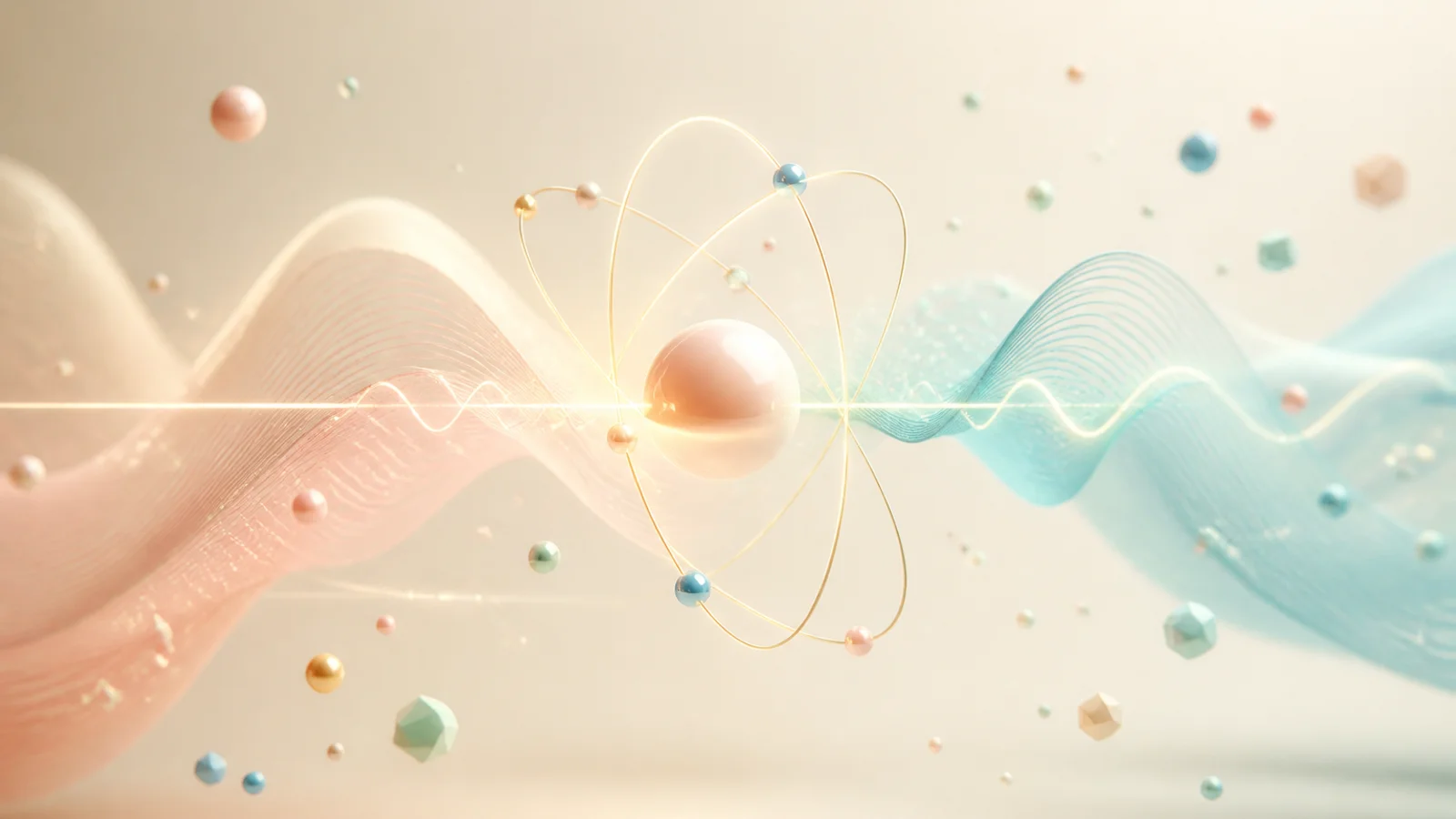
String theory is an idea in theoretical physics that suggests the most basic ingredients of the universe may not be tiny point-like particles, but incredibly small vibrating strings.
Different vibrations could appear to us as different particles.
That is the shape of the idea.
Not the whole theory. Not the math. Not the “please hand me a chalkboard and seven years” version.
Just the doorway.
And for now, the doorway is enough.
The simple version
In many basic physics explanations, particles are treated like tiny points.
An electron is a point.
A quark is a point.
A photon is a point.
Not little balls exactly, but point-like objects with properties such as mass, charge, and spin.
String theory asks a different question:
What if the smallest things are not points, but tiny one-dimensional strings?
Not strings like shoelaces.
Not guitar strings you could pluck with extremely determined fingers.
These strings would be unimaginably tiny.
So tiny that we do not see them directly.
The idea is that different particles might be different vibrations of these strings.
A string vibrating one way might look like one particle.
A string vibrating another way might look like a different particle.
This is the analogy people often use:
A violin string can produce different notes depending on how it vibrates.
In string theory, a fundamental string could produce different particles depending on how it vibrates.
That is the beginner-friendly version.
Reality as music, but the instrument is microscopic and the sheet music is math.
Very normal.
Why physicists wanted a new idea
Physics has two extremely successful theories that do not play nicely together.
The first is general relativity.
This is Einstein’s theory of gravity. It describes huge things: planets, stars, galaxies, black holes, the shape of spacetime.
General relativity is excellent at the large-scale universe.
The second is quantum mechanics.
This describes very small things: atoms, particles, probabilities, uncertainty, and behavior that makes everyday intuition quietly leave the room.
Quantum mechanics is excellent at the small-scale universe.
The problem is that when you try to combine them in extreme situations, things get difficult.
Very difficult.
Black-hole-level difficult.
Big-Bang-level difficult.
The kind of difficult where the math starts behaving like it found a loophole in reality.
Physicists would like a theory that can describe gravity and quantum behavior together.
This is often called a theory of quantum gravity.
String theory is one attempt to build that kind of framework.
It tries to treat particles and forces in a way that could include gravity at the quantum level.
That is one reason physicists care about it.
Not because “tiny strings” is a cute idea.
Though honestly, it is a little cute.
They care because gravity and quantum mechanics are both important, and getting them to work together is one of the biggest puzzles in physics.
Why points cause problems
Here is one reason strings are interesting.
Point-like particles have no size.
In some calculations, that can create problems, especially when gravity enters the quantum world.
Very roughly, if you treat interactions as happening at exact points, some calculations can produce infinities.
In physics, infinities are often a sign that something has gone sideways.
Not always. But often enough that everyone starts looking uncomfortable.
String theory softens the picture.
Instead of interactions happening at zero-size points, strings have tiny length. They spread interactions out in a different way.
That can make certain mathematical problems easier to handle.
This does not mean string theory is automatically proven.
It means the framework has mathematical features that made physicists take it seriously.
The strings are not just a decorative metaphor.
They are a different way of describing the smallest ingredients of reality.
And by “smallest,” I mean so small that your imagination is not properly equipped for the scale.
Mine certainly is not.
My imagination still thinks a grain of dust is impressive.
The extra dimensions part
This is where many people either get excited or quietly escape.
String theory usually requires more dimensions than the four we experience in everyday life.
We are used to:
- three dimensions of space;
- one dimension of time.
That gives us the familiar spacetime picture.
String theory often works mathematically in more dimensions. Depending on the version, you may hear about 10 dimensions, 11 dimensions, or other related ideas.
This sounds ridiculous at first.
Fair.
Extra dimensions feel like the kind of thing someone adds when the normal universe is not complicated enough.
But dimensions do not necessarily have to be large and obvious.
One common explanation is that extra dimensions could be curled up or compactified at incredibly tiny scales.
Imagine a garden hose viewed from far away.
From a distance, it might look like a one-dimensional line.
But up close, you can see that it has a circular dimension around it.
The extra dimension was there. It was just too small to notice from far away.
That analogy is not perfect, because physics analogies are brave little boats in a storm.
But it helps show the idea:
A dimension can exist without being obvious at human scale.
String theory suggests extra dimensions may be hidden in ways we cannot easily perceive.
This is one of the strangest parts.
Also one of the reasons the topic sounds like it was designed to make beginners suspicious.
What does “vibrating” mean?
When people say strings vibrate, they do not mean little strings shaking in normal space like guitar strings on a stage.
This is not a tiny concert inside the universe.
The “vibration” refers to possible modes or patterns of the string.
Different modes correspond to different properties.
In a simplified picture:
- one vibration pattern might appear as one particle;
- another pattern might appear as another particle;
- the particle’s properties come from how the string vibrates.
The important idea is that particles are not treated as completely separate basic objects.
Instead, they might be different expressions of the same underlying kind of thing.
That is elegant.
It is also very hard to test.
Physics enjoys doing this: offering you a beautiful idea and then hiding the experimental receipt.
Why string theory is hard to test
String theory deals with extremely tiny scales.
Far, far smaller than anything we can currently probe directly.
That makes testing it difficult.
In science, being mathematically beautiful is not enough.
A theory needs contact with evidence.
It needs predictions, measurements, experiments, observations, or some way to compare it with reality.
This is one of the big criticisms of string theory.
Some people argue that it is too difficult to test directly and that it has not produced clear experimental predictions.
Others argue that it remains valuable because it offers deep mathematical tools, possible routes toward quantum gravity, and useful ideas that connect different areas of physics.
This is where I think beginners deserve honesty:
String theory is not a confirmed description of reality.
It is a major theoretical framework.
It is studied seriously.
It has influenced mathematics and physics.
It may point toward something important.
But it is not a finished, proven explanation of the universe.
That distinction matters.
Science is allowed to explore bold ideas.
But bold is not the same as confirmed.
Why people still care
If string theory is hard to test, why do physicists still care?
Because it tries to solve enormous problems.
It offers a possible way to include gravity in a quantum framework.
It has revealed surprising mathematical connections.
It has influenced ideas about black holes, quantum field theory, geometry, and the structure of physical laws.
It also gives physicists a language for thinking about questions that are otherwise brutally difficult.
I think of it like building a very ambitious map of a place nobody can visit directly yet.
The map might not be final.
Parts may be wrong.
Some paths may go nowhere.
But the process of making the map can still teach you things about the landscape.
That does not mean we should believe every dramatic claim about string theory.
It means the topic is more serious than “tiny strings, extra dimensions, wow.”
There is real work behind it.
There is also real debate.
Both things can be true.
What string theory is not
Let’s clear up a few things.
It is not proven fact
String theory is not confirmed by direct experimental evidence.
It is a theoretical framework.
A very sophisticated one, but still not a settled fact about the universe.
It is not “everything is literally made of string” in the normal sense
The strings in string theory are not physical strings like thread or wire.
They are mathematical objects used to describe fundamental behavior at extremely tiny scales.
It is not a quick explanation of consciousness, destiny, or why your printer stopped working
People sometimes attach big mysterious ideas to physics terms because they sound deep.
Please be careful with that.
String theory is already complicated enough without someone using it to explain Mercury retrograde, manifestation, or why a toaster has vibes.
It is not useless just because it is hard to test
This one matters too.
A theory can be unconfirmed and still mathematically useful, intellectually important, or connected to other discoveries.
Science is not only a shelf of finished answers.
It is also a workshop full of unfinished tools.
Some tools break.
Some tools become important later.
Some tools teach you that your original question was shaped wrong.
A beginner-friendly mental picture
Here is the version I keep in my head.
Imagine that reality has a deeper layer than the particles we usually talk about.
At that deeper layer, the basic ingredients might be tiny strings.
Those strings can vibrate in different ways.
Different vibrations appear as different particles.
To make the math work, the theory may require extra dimensions that are curled up too small for us to notice.
The hope is that this framework could help connect quantum mechanics with gravity.
That is string theory in a small, careful box.
Not the full beast.
But enough to recognize it when it walks into a conversation wearing equations.
Why this matters outside physics
Most people do not need string theory for everyday life.
You can buy groceries, send emails, open websites, and argue with your printer without knowing anything about vibrating strings.
But I still think topics like this are worth explaining.
Not because everyone needs to become a physicist.
Because difficult ideas shape culture.
They appear in documentaries, headlines, books, science fiction, YouTube videos, and late-night “wait, what is reality?” spirals.
The better we understand the basic shape of an idea, the less likely we are to be intimidated by it or fooled by someone using it as decorative mystery.
This is the same reason I like explaining what AI really is without turning it into a sci-fi sermon.
Big ideas become less scary when someone removes the smoke machine.
String theory may still be hard.
But “hard” and “impossible to begin understanding” are not the same thing.
A tiny glossary
String theory
String theory is a theoretical framework suggesting that fundamental particles may be tiny vibrating strings rather than point-like objects.
Fundamental particle
A fundamental particle is a particle that is not known to be made of smaller parts.
In string theory, what we call particles might come from different string vibrations.
Quantum mechanics
Quantum mechanics is the branch of physics that describes the behavior of very small things, such as atoms and particles.
It is extremely successful and extremely rude to everyday intuition.
General relativity
General relativity is Einstein’s theory of gravity.
It describes gravity as the curvature of spacetime and works very well for large-scale objects like planets, stars, and black holes.
Quantum gravity
Quantum gravity is the attempt to describe gravity using quantum principles.
This is one of the big unsolved problems in physics.
Dimension
A dimension is a direction or way something can vary.
We experience three dimensions of space and one of time, but string theory often involves extra dimensions.
Compactification
Compactification is the idea that extra dimensions may be curled up at very tiny scales, making them hard to observe directly.
Vibration mode
A vibration mode is a pattern in how a string vibrates.
In string theory, different modes could correspond to different particles.
Supersymmetry
Supersymmetry is a theoretical idea that relates different types of particles.
It appears in many versions of string theory, but it has not been confirmed experimentally.
Brane
A brane is a higher-dimensional object in some versions of string theory.
Yes, the word sounds like someone dropped part of “membrane” and decided it was fine.
My take
String theory is one of those topics where the honest answer is not simple.
It is beautiful.
It is strange.
It is mathematically deep.
It is not experimentally confirmed.
It may be a path toward understanding quantum gravity.
It may also be an incomplete map that points toward something else.
That uncertainty does not make it worthless.
It makes it science.
The part I like most is the shift in perspective.
Instead of imagining the universe as a pile of tiny separate particles, string theory asks whether those particles might be different notes played by the same deeper instrument.
That is a gorgeous idea.
Maybe reality works that way.
Maybe it does not.
But even as an idea, it stretches the mind in a useful direction.
And sometimes that is enough for a first explanation.
Not certainty.
Not final answers.
Just a better doorway into a very difficult room.

Jane Calder
I'm Jane Calder, the writer behind Jane Decodes. I research AI, crypto, 3D, web technology, and strange science rabbit holes, then turn them into plain-English explanations for people who like learning but dislike being attacked by jargon.
Usually powered by coffee, browser tabs, and the stubborn belief that almost anything can be explained better.
Related posts
What Is a Black Hole? Not a Space Vacuum Cleaner
A beginner-friendly explanation of black holes, gravity, event horizons, spacetime, singularities, and why black holes are not cosmic vacuum cleaners.
Read article →
What Is Entropy? Why Everything Gets Messier Unless Something Works Hard
A beginner-friendly explanation of entropy, disorder, energy, probability, heat, and why the universe seems to prefer messier arrangements.
Read article →
Schrödinger's Cat Explained Without Making the Cat Do All the Work
A beginner-friendly explanation of Schrödinger's cat, quantum superposition, measurement, and why the famous cat is not really the main point.
Read article →