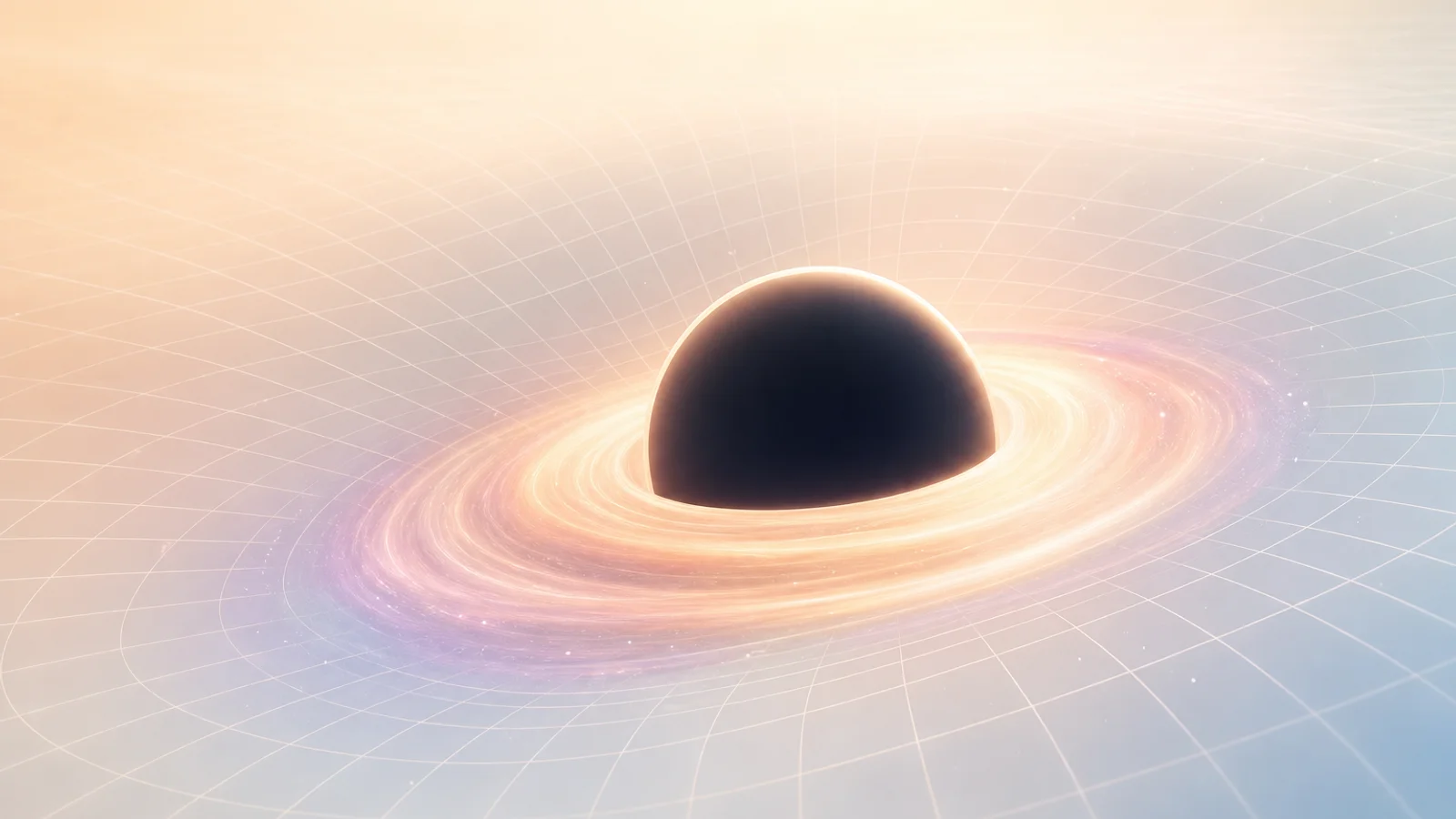
Black holes have excellent branding.
They sound dark.
Mysterious.
Dangerous.
Like something the universe keeps behind a locked door with a sign that says:
Do not touch. Seriously.
And because black holes are so dramatic, they collect dramatic misunderstandings.
People often imagine them as cosmic vacuum cleaners, roaming through space and sucking up everything nearby with rude enthusiasm.
That is not quite right.
A black hole is not a hungry space monster.
It is not a magic drain.
It is not a hole in the universe in the everyday sense.
The simple version is this:
A black hole is a region of space where gravity is so strong that nothing, not even light, can escape once it gets too close.
That is already strange enough.
We do not need to add a vacuum cleaner.
The simple version
A black hole forms when a lot of mass is packed into a very small region.
Mass creates gravity.
More mass in a smaller space creates stronger gravity.
If the gravity becomes strong enough, there is a boundary around the object where escape becomes impossible.
That boundary is called the event horizon.
Outside the event horizon, things can still orbit a black hole, move near it, or even escape if they are not too close and have the right path.
Inside the event horizon, escape is no longer possible.
Not because the object is sticky.
Not because the black hole is reaching out with invisible space tentacles.
Because spacetime itself is curved so strongly that every possible path leads inward.
That sentence sounds intense because it is.
Black holes are what happens when gravity stops being background furniture and becomes the main character.
Not a space vacuum cleaner
This is the misunderstanding I want to gently escort out of the room.
Black holes do not automatically suck in everything around them.
If the Sun were magically replaced by a black hole with the same mass, Earth would not instantly fall in.
It would keep orbiting the same mass from the same distance.
We would have many other problems, obviously.
The sunlight situation would become extremely poor.
Plants would object.
Everyone would object.
But gravitationally, from Earth’s distance, the orbit would not suddenly become a spiral into doom just because the mass became a black hole.
The danger comes when something gets too close.
Black holes are not special because they pull from far away with extra magical suction.
They are special because their mass is compressed into such a small space that you can get extremely close to a huge amount of gravity.
Near the event horizon, the rules become much less friendly.
So the better mental picture is:
A black hole is not a vacuum cleaner. It is an extremely deep gravitational pit.
If you stay far enough away, you can orbit.
If you get too close, the exit signs stop being relevant.
The event horizon
The event horizon is the point of no return.
It is not a physical surface like a wall or shell.
You would not bump into it.
It is a boundary in spacetime.
Once something crosses it, it cannot send information back out.
That includes light.
And if light cannot escape, then we cannot see anything from inside that boundary.
This is why black holes are black.
Not because they are made of black material.
Not because someone painted space with the wrong brush.
They are black because light that crosses the event horizon cannot come back to your telescope and say hello.
The event horizon is also why black holes are so fascinating.
They are not just objects.
They are limits.
A black hole draws a line between the universe we can receive information from and the region we cannot.
That is unsettling.
Science is allowed to be unsettling.
Sometimes it brings snacks.
Sometimes it brings event horizons.
Gravity and spacetime
To understand black holes, we need to talk about gravity.
In everyday life, gravity feels like a force pulling things downward.
You drop a mug.
The mug falls.
You feel gravity.
The mug feels regret.
But in Einstein’s general relativity, gravity is described differently.
Mass and energy curve spacetime.
Objects move through that curved spacetime.
A common analogy is a stretched rubber sheet.
Put a heavy ball on it, and the sheet curves.
Smaller objects roll around that curve.
This analogy is imperfect, because spacetime is not actually a rubber sheet and the universe did not come with a trampoline.
But it gives the shape of the idea:
Mass changes the geometry around it.
A black hole curves spacetime so strongly that, past the event horizon, all paths lead inward.
It is not simply pulling harder in the normal sense.
It is changing what “forward” can mean.
That is the part that makes black holes feel less like objects and more like reality folding itself into a very serious knot.
How black holes form
One common way black holes form is through the death of massive stars.
A star spends much of its life balancing two things:
- gravity pulling inward;
- pressure from nuclear fusion pushing outward.
That balance keeps the star stable.
For a while.
Stars are not permanent.
They are more like cosmic campfires with excellent commitment.
When a massive star runs out of fuel, it can no longer support itself against gravity in the same way.
The core collapses.
The outer layers may explode as a supernova.
If the remaining core is massive enough, gravity wins completely and a black hole can form.
Not every star becomes a black hole.
Smaller stars have different endings.
Our Sun, for example, is not massive enough to become a black hole.
It has other plans.
Still dramatic.
Less black-hole dramatic.
What is at the center?
You may hear that a black hole contains a singularity.
A singularity is often described as a point where density becomes infinite and the usual laws of physics break down.
That is the standard dramatic version.
But beginners deserve a careful version.
In general relativity, if you follow the math inward, the collapse points toward a singularity.
But many physicists think this is a sign that our current theories are incomplete at that extreme.
When gravity becomes incredibly strong and quantum effects should matter, general relativity may not be enough.
This is one reason black holes are important in theoretical physics.
They sit at the border between gravity, quantum mechanics, information, thermodynamics, and several questions that make physicists look both excited and tired.
Topics like string theory are partly interesting because physicists want better ways to think about gravity at extremely small scales.
Black holes are one of the places where that problem becomes impossible to ignore.
They are not just cosmic curiosities.
They are physics stress tests.
Can black holes grow?
Yes.
Black holes can grow by gaining mass.
They may consume gas, dust, stars, or other matter that gets too close.
They can also merge with other black holes.
But again, they are not sucking up the universe from across the room.
Matter usually needs to lose energy and fall inward.
A lot of material near a black hole can form an accretion disk.
This is a spinning disk of gas and dust heating up as it moves around the black hole.
Accretion disks can become incredibly hot and bright.
This is one of the funny things about black holes:
The black hole itself emits no light from inside the event horizon.
But the material around it can shine violently.
A black hole can be invisible and surrounded by a cosmic disaster lamp.
Space has style.
Terrible, terrifying style.
Why black holes can be bright
This sounds like a contradiction.
Black holes are black.
But black hole environments can be bright.
The light comes from matter outside the event horizon.
As gas and dust spiral inward, friction, compression, and magnetic effects can heat the material to extreme temperatures.
That hot material emits radiation.
In some cases, black holes can power some of the brightest objects in the universe, such as quasars.
A quasar is an extremely bright active galactic nucleus powered by a supermassive black hole feeding on material.
That sentence sounds like science fiction trying to win a vocabulary contest.
But the idea is simple enough:
The black hole is dark. The material falling around it can glow.
The campfire is not inside the point of no return.
It is around it.
A very aggressive campfire.
Supermassive black holes
Some black holes are formed from collapsed stars.
Others are enormous.
At the centers of many galaxies, including our Milky Way, there are supermassive black holes.
These can have millions or billions of times the mass of the Sun.
How exactly supermassive black holes formed and grew is still an active area of research.
They may grow through accretion, mergers, and early-universe processes that are still being studied.
The black hole at the center of our galaxy is called Sagittarius A*.
It is supermassive, but relatively quiet compared with some active galactic nuclei.
I enjoy the idea of a supermassive black hole being “quiet.”
That is the kind of phrase astronomy says with a straight face.
A quiet supermassive black hole is still not something you invite to dinner.
What happens if you fall in?
First, let us agree not to test this.
If you fell toward a black hole, what happened would depend on the size of the black hole.
Near a smaller black hole, tidal forces could become extreme before you reached the event horizon.
Tidal forces happen because gravity pulls more strongly on the part of you closer to the black hole than the part farther away.
This stretching effect is sometimes called spaghettification.
Physics looked at one of the most horrifying possible fates and named it after pasta.
I have questions.
For a very large black hole, the event horizon can be so large that you might cross it without noticing anything dramatic at that exact boundary.
But once inside, escape is still impossible.
You would not be able to send a message back out.
No postcard.
No final review.
No “the inside is weird, please advise.”
The event horizon is not about how dramatic the crossing feels.
It is about whether escape remains possible.
And it does not.
Black holes and entropy
Black holes are also connected to entropy, which is one of the reasons they are so important in physics.
Entropy is often linked to disorder, possible arrangements, and information. I explained the beginner version in what entropy is.
Black holes have entropy too.
In fact, black hole entropy is connected to the area of the event horizon, not the volume inside it.
That is strange.
Very strange.
It led to deep ideas about information, gravity, quantum mechanics, and whether the universe may store information in ways that do not match our everyday expectations.
For a beginner article, we do not need to dive all the way into that pool.
The shallow end is already deep.
The important point is:
Black holes are not just “things that eat stuff.” They connect several of the hardest questions in physics.
Gravity.
Time.
Entropy.
Information.
Quantum mechanics.
The universe did not choose a simple subject area here.
Can black holes disappear?
Surprisingly, yes — at least in theory.
Stephen Hawking showed that black holes should not be completely black.
Because of quantum effects near the event horizon, black holes may slowly emit radiation.
This is called Hawking radiation.
Over an unimaginably long time, a black hole could lose mass and eventually evaporate.
For large black holes, this process is incredibly slow.
So slow that it is not something to worry about in any normal practical sense.
Your leftovers will become questionable long before a stellar black hole evaporates.
Still, the idea is huge.
It means black holes are not simply eternal one-way traps in the most basic sense.
They are connected to quantum effects, thermodynamics, and information.
Again, black holes are physics stress tests.
Every time you think the topic is just “space hole,” another doorway opens.
Common misunderstandings
Let’s clear up a few black hole myths.
”Black holes suck everything in”
No.
They have gravity like other massive objects.
If you are far enough away and moving correctly, you can orbit a black hole.
The danger is getting too close.
”A black hole is literally an empty hole”
Not exactly.
It is a region of spacetime with gravity so strong that nothing can escape from inside the event horizon.
The word “hole” is useful, but not perfect.
”The event horizon is a solid surface”
No.
It is a boundary.
You would not hit it like a wall.
”Black holes are always huge”
Not necessarily.
Black holes can have different masses.
Some are stellar-mass black holes.
Some are supermassive black holes.
The event horizon size depends on mass.
”We can see inside a black hole”
No.
Information from inside the event horizon cannot escape.
We study black holes by observing their effects on nearby matter, light, stars, gas, and spacetime.
A tiny glossary
Black hole
A black hole is a region of space where gravity is so strong that nothing can escape once it crosses the event horizon.
Event horizon
The event horizon is the boundary around a black hole beyond which escape is impossible.
Gravity
Gravity is the effect of mass and energy curving spacetime, described by general relativity.
Spacetime
Spacetime is the combined fabric of space and time used in modern physics.
Singularity
A singularity is where general relativity predicts extreme conditions, often described as infinite density.
It may also signal that our theories are incomplete there.
Accretion disk
An accretion disk is a spinning disk of gas and dust around a compact object such as a black hole.
Supernova
A supernova is a powerful stellar explosion that can happen at the end of a massive star’s life.
Supermassive black hole
A supermassive black hole has millions or billions of times the mass of the Sun and often sits at the center of a galaxy.
Hawking radiation
Hawking radiation is theoretical radiation that black holes may emit because of quantum effects near the event horizon.
Spaghettification
Spaghettification is the stretching effect caused by extreme tidal forces near a black hole.
The name is absurd.
The physics is not.
My take
Black holes are not cosmic vacuum cleaners.
They are not magic drains.
They are not holes in the everyday sense.
They are regions where gravity becomes so strong that spacetime itself traps anything crossing the event horizon.
That idea is already more interesting than the myth.
The myth says:
Black holes eat everything.
The real version says:
Black holes show us what happens when gravity becomes extreme enough to bend the rules of escape, light, time, and information.
That is much better.
Much stranger.
Much more useful.
I like black holes because they are simple at the doorway and impossible in the basement.
The doorway is:
too much mass in too little space creates gravity so strong that light cannot escape.
The basement is:
entropy, quantum gravity, singularities, information, Hawking radiation, spacetime, and physicists arguing beautifully for decades.
That is a good science topic.
A clean first idea.
A terrifying staircase underneath.
Black holes do not need to be space monsters to be interesting.
They are already reality’s way of saying:
Let’s see how far your understanding of physics can bend.

Jane Calder
I'm Jane Calder, the writer behind Jane Decodes. I research AI, crypto, 3D, web technology, and strange science rabbit holes, then turn them into plain-English explanations for people who like learning but dislike being attacked by jargon.
Usually powered by coffee, browser tabs, and the stubborn belief that almost anything can be explained better.
Related posts

What Is Entropy? Why Everything Gets Messier Unless Something Works Hard
A beginner-friendly explanation of entropy, disorder, energy, probability, heat, and why the universe seems to prefer messier arrangements.
Read article →
Schrödinger's Cat Explained Without Making the Cat Do All the Work
A beginner-friendly explanation of Schrödinger's cat, quantum superposition, measurement, and why the famous cat is not really the main point.
Read article →
String Theory, Explained Without Melting Your Brain
A beginner-friendly explanation of string theory, extra dimensions, vibrating strings, and why physicists care about it — without pretending it is simple.
Read article →