Entropy is one of those science words people use when they want to sound like they understand why their desk is a disaster.
And honestly, I respect the attempt.
“My room is messy because of entropy” sounds much better than “I have been using a chair as a laundry management system.”
But entropy is not just a fancy word for mess.
It is connected to disorder, energy, probability, heat, time, and one of the deepest reasons the universe seems to have a direction.
That sounds enormous.
It is enormous.
But we can start smaller.
Start with a clean desk.
You place a notebook in the corner.
A pen beside it.
A mug on a coaster.
A cable neatly wrapped.
The room looks calm.
Then life happens.
You use the pen.
You move the mug.
You unwrap the cable.
You open the notebook.
A receipt appears from nowhere.
A second cable joins the first cable and they immediately begin their ancient ritual of becoming one creature.
After a while, the desk is messier.
Nobody is shocked.
The strange part is not that things become messy.
The strange part is that things rarely become organized by accident.
That is the doorway into entropy.
The simple version
Entropy is a measure of how many ways a system can be arranged while still looking basically the same from a big-picture view.
That sentence sounds harmless until it starts rearranging your brain furniture.
So here is the more human version:
Entropy describes how spread out, mixed up, or statistically likely a system’s state is.
A neat desk has fewer possible arrangements.
A messy desk has many possible arrangements.
There are only a few ways to place everything neatly.
There are many, many ways to scatter papers, pens, cables, crumbs, and one mysterious screw you do not remember owning.
That is why mess tends to happen easily.
There are more ways to be messy than tidy.
This is one of the core ideas behind entropy.
Not “the universe loves chaos” in a dramatic villain voice.
More like:
There are simply more disorderly arrangements available.
The universe is not necessarily trying to ruin your desk.
It just has options.
Too many options.
Entropy is not exactly “mess”
People often explain entropy as disorder.
That is useful as a starting point.
But it can also be misleading.
“Disorder” sounds like a room, a junk drawer, or a cable box that has become a small ecosystem.
Entropy is broader than that.
In physics, entropy is about the number of possible microscopic arrangements that match the same overall state.
A system can look simple from far away while having many possible internal arrangements.
For example, a glass of water looks like a glass of water.
But inside, the water molecules are moving around in countless possible ways.
The big-picture state looks the same:
room-temperature water in a glass.
But the microscopic details can vary enormously.
Entropy is connected to those possible arrangements.
So when people say entropy means “disorder,” they are pointing at the right neighborhood.
But the full idea is more about probability and possible states.
Mess is the friendly metaphor.
Microstates are the technical furniture.
I prefer entering through the friendly metaphor, because physics already owns enough intimidating doors.
The coin example
Let’s use coins.
Imagine you flip four coins.
You could get:
HHHHAll heads.
Very neat.
Very specific.
Or you could get:
HTHT
THHT
THTH
HTTH
and many other mixed combinations.
There is only one way to get all heads.
There is only one way to get all tails.
But there are many ways to get a mixture of heads and tails.
So if you flip coins randomly, a mixed result is more likely than a perfectly ordered result.
Not because the coins prefer chaos.
Coins are not emotionally invested.
The mixed result is more likely because there are more ways for it to happen.
That is a useful entropy idea:
States with more possible arrangements are more likely.
Now scale that up from four coins to gas molecules in a room.
Or heat moving through an object.
Or particles spreading out.
The numbers become enormous.
So enormous that “possible arrangements” stops feeling like a casual phrase and starts feeling like the universe owns a spreadsheet too large to open.
The perfume example
A classic entropy example is perfume in a room.
You spray perfume in one corner.
At first, the scent molecules are concentrated near where you sprayed.
Over time, they spread through the room.
Eventually, the smell becomes more evenly distributed.
Why?
Because there are far more ways for perfume molecules to be spread out than clustered in one corner.
A clustered arrangement is possible.
But it is very specific.
A spread-out arrangement has many more possible configurations.
So the molecules move, collide, bounce around, and the system naturally heads toward a more probable state.
This is why perfume does not usually gather itself back into the bottle.
Which is rude, because that would be very convenient.
But statistically, the spread-out state is overwhelmingly more likely.
That is entropy at work.
Not as a mystical force.
As probability playing the long game.
Heat and entropy
Entropy is deeply connected to heat.
Heat is energy moving from warmer things to cooler things.
If you put a hot mug of tea on a table, it cools down.
The heat spreads into the surrounding air, the mug, the table, and eventually the room.
You do not see a cold mug of tea spontaneously pull heat out of the room and become hot again.
If that happens, stop reading and call several physicists.
In ordinary life, heat flows from hot to cold.
This is connected to the second law of thermodynamics.
A simple version:
In an isolated system, entropy tends to increase over time.
That does not mean every single thing everywhere becomes messier every second in the most obvious way.
It means the total entropy of an isolated system tends to go up.
Energy spreads out.
Differences even out.
Hot and cold move toward thermal balance.
The tea cools.
The ice melts.
The room becomes boringly closer to one temperature.
Thermodynamics is very powerful.
Also slightly depressing if you are emotionally attached to hot tea.
Why ice melts
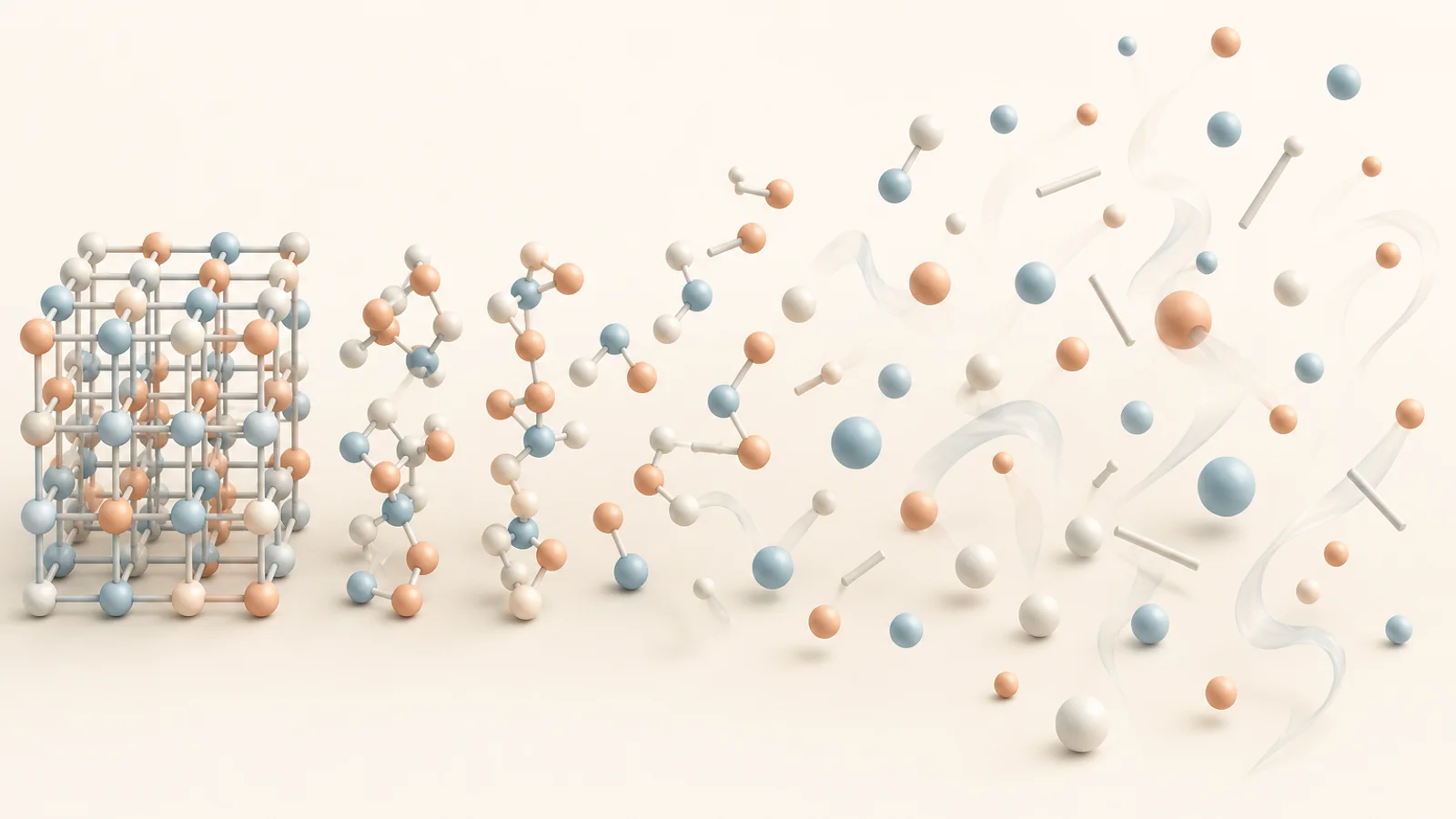
Ice melting is a useful entropy example.
In ice, water molecules are arranged in a more ordered structure.
In liquid water, the molecules move more freely and have many more possible arrangements.
When ice absorbs heat, the molecules gain energy and the rigid structure breaks down.
The ice becomes liquid.
From an entropy point of view, liquid water has more possible molecular arrangements than solid ice.
So melting increases entropy.
This does not mean ice is “better” or water is “worse.”
Physics is not judging your drink.
It is describing how energy and molecular arrangements behave.
If you leave ice in a warm room, it melts because heat flows into it and the molecular structure changes.
To freeze water again, you need to remove heat.
That takes work.
Your freezer does that work.
Quietly.
Usually without asking for appreciation.
Which is why I think freezers deserve more emotional credit.
Entropy and time
Entropy is often connected to the arrow of time.
This phrase sounds poetic because it is.
In many basic physical laws, time can look reversible.
For example, if you watch a video of two billiard balls colliding, the motion might look physically possible forward or backward.
But many everyday processes are clearly one-directional.
A glass falls and shatters.
It does not usually reassemble itself and jump back onto the table.
Cream mixes into coffee.
It does not unmix into a perfect white swirl and black coffee again.
A messy room can be cleaned, but only if someone does work.
It does not usually clean itself while you are out, unless you live with a very generous person or a suspiciously talented robot.
Entropy helps explain why time feels like it has a direction.
The future is the direction in which entropy tends to increase.
That is a huge idea.
A broken egg is more likely than an unbroken egg assembling itself from a splatter.
A mixed coffee is more likely than cream and coffee separating perfectly.
A scattered deck is more likely than a perfectly sorted deck.
There are more ways for things to be mixed, spread out, broken, or disordered than perfectly arranged.
So time seems to move from less probable arrangements toward more probable ones.
The universe does not need a calendar.
It has entropy.
Does entropy mean everything gets worse?
Not exactly.
This is a common misunderstanding.
Entropy increasing does not mean every local place becomes more chaotic all the time.
Local order can increase.
Your room can become clean.
A plant can grow.
A snowflake can form.
A living body can maintain structure.
A website can become organized after someone spends too many hours adjusting CSS and whispering threats at a layout bug.
Local order is possible.
But it usually requires energy and increases entropy somewhere else.
You clean your room by using energy.
Your body turns food into work and heat.
The vacuum cleaner uses electricity and releases heat.
The room becomes more ordered, but the overall process still fits with entropy increasing in the larger system.
This is the key:
Entropy can decrease locally if energy is used and entropy increases elsewhere.
That is why life does not violate the second law of thermodynamics.
Living things maintain order by taking in energy and releasing waste heat.
A plant grows by using energy from sunlight.
A human organizes a drawer by using calories, patience, and possibly mild frustration.
Order is possible.
It just has a cost.
Why mixing is easier than unmixing
Mixing is one of the easiest ways to feel entropy.
Put cream in coffee.
At first, there is a visible swirl.
Then the cream spreads.
Eventually, the coffee looks evenly mixed.
To unmix it, you would need to separate the cream molecules from the coffee molecules.
Good luck.
That is not just difficult because humans lack tiny spoons.
It is difficult because the mixed state has vastly more possible arrangements than the separated state.
The separated state is special.
The mixed state is common.
Nature does not need to “prefer” mixing.
Random motion plus probability does the work.
This is why many processes are easy in one direction and extremely hard in reverse.
Shuffling cards is easy.
Returning them to perfect order by random shuffling is technically possible but realistically ridiculous.
Breaking a glass is easy.
Reassembling it by shaking the pieces in a box is not a plan.
Please do not try.
Entropy and information
Entropy also appears in information theory.
This is related, but not identical to thermodynamic entropy.
In information theory, entropy measures uncertainty or unpredictability.
For example, a message with a very predictable pattern has low information entropy.
A message with many possible outcomes has higher entropy.
If I tell you the next word in this sentence is probably “the,” you are not very surprised.
If I tell you the next word is “accordion,” that carries more surprise.
Probably too much surprise.
Information entropy helps describe how much information is needed to represent uncertainty.
This is used in compression, cryptography, communication, computing, and data science.
The connection between physical entropy and information is deep and fascinating, but also a rabbit hole with a staircase.
For a beginner, I would keep the basic idea:
Entropy is often about how many possibilities exist and how uncertain or spread out a system is.
In physics, that can mean molecular arrangements and energy.
In information theory, it can mean uncertainty in messages or data.
Same family of ideas.
Different rooms in the house.
Entropy and life
Life looks like it fights entropy.
A living organism is organized.
Cells are structured.
DNA carries information.
Bodies maintain temperature.
Plants build complex forms.
Brains organize experience.
My kitchen, unfortunately, is less cooperative.
But life does not break the rules.
Living systems maintain local order by using energy.
Food, sunlight, oxygen, chemical energy — life takes in energy and matter, uses them to build and maintain structure, and releases heat and waste.
A living thing is not a closed system sitting there politely ignoring the universe.
It is constantly exchanging energy and matter with its environment.
That exchange allows local order to continue.
This is why a plant can grow from sunlight, water, carbon dioxide, and nutrients.
It becomes more organized locally.
But the larger energy flow still increases entropy overall.
Life is not anti-entropy magic.
Life is organized energy flow.
Which is still amazing.
Maybe more amazing, because it works without needing magic.
Common beginner misunderstandings
Entropy attracts misunderstandings because it sits near big words like disorder, time, chaos, and the fate of the universe.
Let’s clear up a few.
”Entropy means chaos”
Not exactly.
Chaos is a different concept in physics and mathematics.
Entropy is more about possible arrangements, probability, energy spreading, and uncertainty.
Mess is a useful metaphor.
It is not the whole definition.
”Entropy means everything always becomes messy”
Not locally.
Local order can increase if energy is used.
Your desk can be cleaned.
A snowflake can form.
A plant can grow.
A baby can learn to stack blocks, then immediately use that skill to create floor-based architecture with sharp corners.
Local order is allowed.
But the total entropy of an isolated system tends to increase.
”Entropy is a force”
Entropy is not a force pushing things around like an invisible hand of mess.
It is a property of systems.
It describes something about possible arrangements and energy distribution.
The universe is not being shoved toward disorder by an entropy goblin.
Although that would explain some drawers.
”Entropy means nothing matters”
This one is more philosophical than scientific.
Yes, entropy connects to the long-term direction of physical processes.
No, that does not mean your choices, projects, relationships, art, or clean kitchen do not matter.
The fact that order takes work is not depressing to me.
It is clarifying.
Meaningful things often require maintenance.
That is not failure.
That is physics being annoyingly poetic.
Entropy and the universe
On the largest scale, entropy connects to the fate of the universe.
You may hear about the “heat death” of the universe.
Cheerful phrase.
The basic idea is that if entropy keeps increasing, energy may eventually become so evenly spread out that no useful energy differences remain to do work.
Stars burn out.
Temperature differences fade.
Processes slow.
The universe approaches a state of maximum entropy.
This is not something to worry about during breakfast.
The timescales are unimaginably huge.
But the idea shows how deep entropy goes.
It is not just about messy desks.
It is connected to energy, time, stars, life, and cosmic history.
Science has a way of starting with “why did my coffee cool down?” and ending with “what is the ultimate fate of the universe?”
Very normal behavior.
If you enjoy difficult physics doorways, I also wrote about string theory without melting your brain and Schrödinger’s cat without making the cat do all the work. Those are different topics, but they share the same theme: reality gets weird when you look closely.
A tiny glossary
Entropy
Entropy is a measure related to the number of possible arrangements of a system, energy spreading, and uncertainty.
In simple terms, higher entropy often means more ways for a system to be arranged.
Thermodynamics
Thermodynamics is the branch of physics that studies heat, energy, work, and how they move through systems.
Second law of thermodynamics
The second law says that in an isolated system, entropy tends to increase over time.
Isolated system
An isolated system is a system that does not exchange energy or matter with its surroundings.
Perfect isolated systems are idealized, but the concept is useful.
Microstate
A microstate is one specific microscopic arrangement of a system.
For example, the exact positions and motions of molecules.
Macrostate
A macrostate is the big-picture state of a system, such as temperature, pressure, and volume.
Many microstates can correspond to the same macrostate.
Disorder
Disorder is a common informal way to describe entropy, but it is not the full technical meaning.
It is a helpful doorway, not the whole house.
Heat
Heat is energy transferred because of a temperature difference.
It usually flows from warmer things to cooler things.
Equilibrium
Equilibrium is a balanced state where large-scale changes stop because energy or matter has become evenly distributed.
Information entropy
Information entropy measures uncertainty or unpredictability in information.
It is related to, but not identical to, physical entropy.
Arrow of time
The arrow of time is the idea that time has a direction, connected to processes like entropy increasing.
My take
Entropy is not just “mess.”
It is not just “everything gets worse.”
It is not a tiny demon tipping over your laundry basket.
Entropy is a way of understanding why some arrangements are more likely than others, why energy spreads out, why heat moves from hot to cold, and why time feels like it points in one direction.
The desk gets messy because there are more messy arrangements than neat ones.
The perfume spreads because there are more spread-out arrangements than clustered ones.
The tea cools because energy moves into the surroundings.
The egg does not reassemble because that would require an insanely specific reversal of an already unlikely mess.
Entropy is one of those ideas that starts small and then quietly takes over the room.
At first, it explains why things mix.
Then it explains why heat flows.
Then it explains why time has an arrow.
Then it starts whispering about the fate of the universe while you are just trying to drink coffee.
I like that kind of idea.
Not because it is comforting.
Because it is clarifying.
Order is possible.
But order takes work.
And suddenly, cleaning a desk feels less like a chore and more like a tiny rebellion against probability.
A temporary rebellion, yes.
But still.
I will take it.

Jane Calder
I'm Jane Calder, the writer behind Jane Decodes. I research AI, crypto, 3D, web technology, and strange science rabbit holes, then turn them into plain-English explanations for people who like learning but dislike being attacked by jargon.
Usually powered by coffee, browser tabs, and the stubborn belief that almost anything can be explained better.
Related posts
What Is a Black Hole? Not a Space Vacuum Cleaner
A beginner-friendly explanation of black holes, gravity, event horizons, spacetime, singularities, and why black holes are not cosmic vacuum cleaners.
Read article →
Schrödinger's Cat Explained Without Making the Cat Do All the Work
A beginner-friendly explanation of Schrödinger's cat, quantum superposition, measurement, and why the famous cat is not really the main point.
Read article →
String Theory, Explained Without Melting Your Brain
A beginner-friendly explanation of string theory, extra dimensions, vibrating strings, and why physicists care about it — without pretending it is simple.
Read article →